

Government of Tamil Nadu
Tamil Nadu Forest Department
Project Nilgiri Tahr / நீலகிரி வரையாடு திட்டம்
Tamil Nadu Forest Department
Pioneering Radio Collaring of Nilgiri Tahr – Tracking the Mountain Monarch
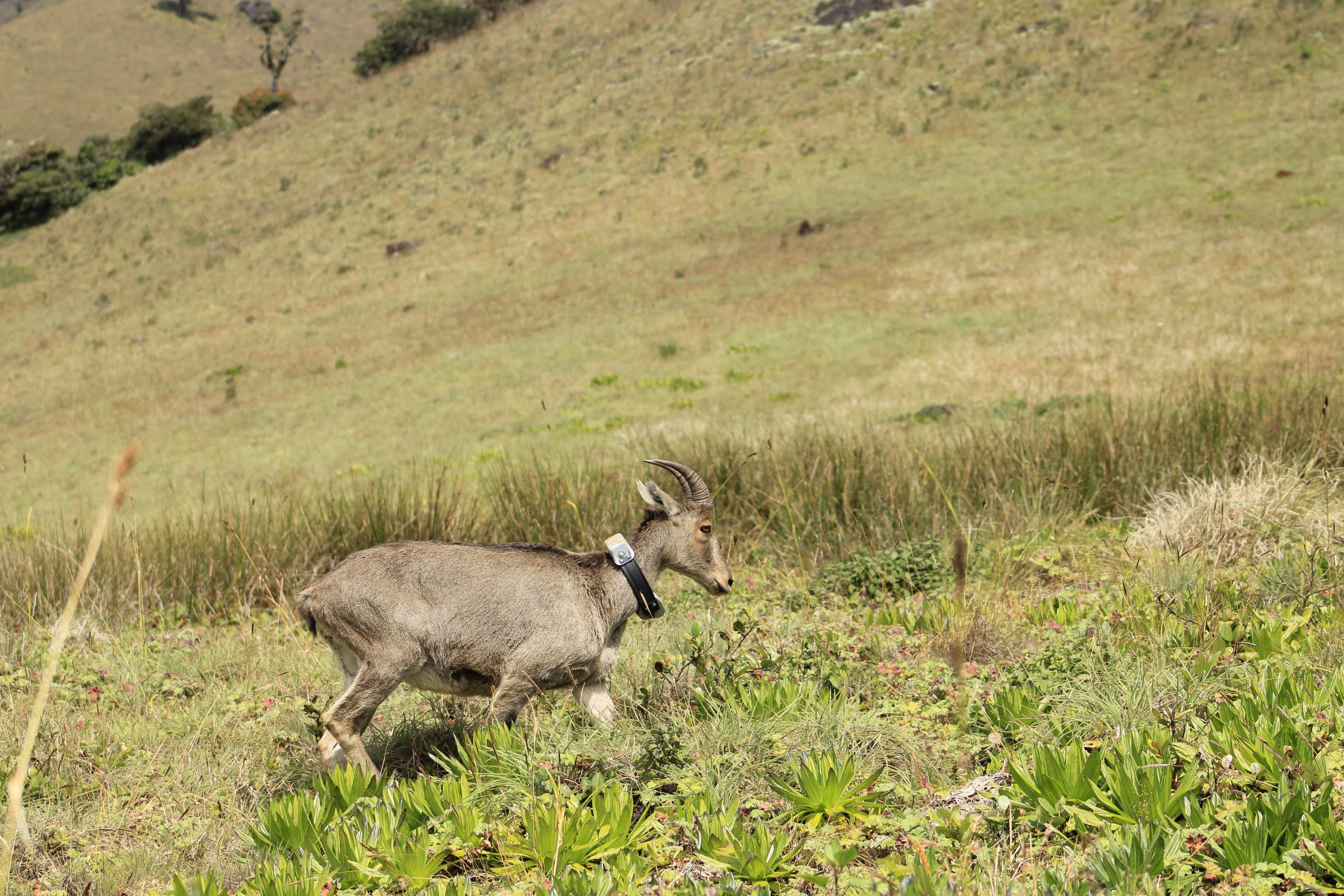
In 2024, Project Nilgiri Tahr achieved a first-of-its-kind feat by successfully radio-collaring wild Nilgiri Tahrs to study their movement, behaviour, and habitat use. With permission from the Government of India to collar 12 individuals, two specialized collars were procured from African Wildlife Tracking and Vectronics Aerospace, Germany, with satellite-linked receivers imported from the United States. This groundbreaking initiative, executed in collaboration with WWF-India, aimed to generate vital ecological data for the long-term conservation of this elusive species.
The first breakthrough came on March 21, 2024, when a saddleback male was collared at Mukurthi National Park. The collar transmitted GPS coordinates every three hours, helping scientists determine a remarkable home range of 414 km². Tragically, this individual was later predated by a wild carnivore in July 2024, but the data it provided has been invaluable for understanding movement patterns. Following this, on August 21, 2024, a young male, aged 3-4 years, was collared near the 7th Hairpin Bend in the Pollachi Division, offering insights into habitat geofencing and behavioural dynamics.
On December 6, 2024, two more individuals—a five-year-old male and an eight-year-old female—were collared in Mukurthi National Park. While the male recovered well and resumed normal activities, the female unfortunately collapsed post-procedure despite careful monitoring. Biological samples such as blood, swabs, and hair were collected during these operations for health and genetic studies.
The radio-collaring project represents a major leap forward in wildlife research. By tracking movements, seasonal migrations, and breeding behaviour, scientists can identify critical corridors and design strategies to connect fragmented populations. Plans are underway to collar 10 more individuals, expanding the database to inform habitat restoration and reintroduction programs. This initiative sets a new benchmark for mountain ungulate research in India.